


















Finding no-KYC crypto platforms that actually work in 2026 has become harder — but not impossible. Crypto regulations tightened significantly this year. The FATF Travel Rule now applies to more jurisdictions, major exchanges have raised identity verification thresholds, and several platforms that once allowed anonymous transactions have quietly added verification steps for amounts above $1,000.
Demand for no-KYC crypto services hasn’t dropped. It’s grown. Users aren’t necessarily trying to avoid taxes or hide illegal activity. Most just want to buy something small with Bitcoin or USDT without uploading a passport photo and waiting three days for approval.
Some platforms still deliver on the no-KYC promise. Others have quietly added verification, or shut down outright. Gift cards turn out to be where the zero-verification model has survived best.
Why No-KYC Is Getting Harder to Find
Until 2024, no-KYC crypto options were everywhere. Then the regulatory landscape shifted:
The EU’s Transfer of Funds Regulation (TFR), which took effect in December 2024 alongside MiCA, requires crypto-asset service providers to verify identity for self-hosted wallet transfers above €1,000 — a threshold the upcoming AML Regulation (AMLR), effective July 2027, will extend to a broader range of transactions. US FinCEN extended Bank Secrecy Act reporting requirements to cover more crypto intermediaries. Visa and Mastercard tightened compliance rules for crypto card issuers, pushing many anonymous prepaid card programs to either add KYC or shut down entirely.
The result: platforms that advertise “no KYC” in 2026 often mean “no KYC for small transactions” — with verification kicking in at $500 or $1,000. That’s not dishonest — but check the fine print before you sign up.
What No-KYC Actually Means Today
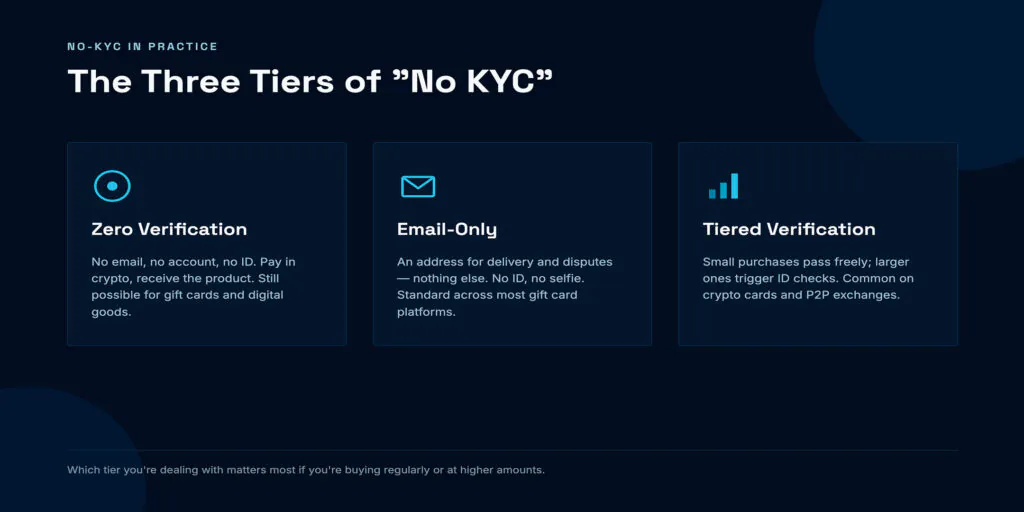
There are three versions of “no KYC” in crypto right now.
Zero verification. No email, no account, no ID. You pay with crypto, receive your product. This is still possible for gift cards and digital goods, but rare for anything involving fiat withdrawal.
Email-only. You provide an email address for delivery and dispute resolution, nothing else. No ID, no selfie, no address. Most crypto gift card platforms operate at this level.
Tiered verification. Small purchases go through without ID; larger ones trigger a verification request. Common on crypto card platforms and P2P exchanges.
Which tier you’re dealing with matters most if you’re buying regularly or at higher amounts.
No-KYC Crypto Platforms That Work in 2026
Gift Card Marketplaces
This category has become the most reliable group of no-KYC crypto platforms under regulatory pressure. Buying a $50 Amazon card with Bitcoin isn’t a financial transaction in the traditional regulatory sense — it’s a purchase.
Cardstorm operates on an email-only model for gift card purchases — no account or ID required, just an email address for delivery. You pick a card, pay in crypto (Bitcoin, USDT, ETH, and others), and receive the code by email. The platform covers 6,000+ gift cards across roughly 800 brands in the US and other markets, with instant delivery after on-chain confirmation.
Bitrefill remains the largest platform in the category but has moved toward requiring accounts for frequent purchases. Lightning Network support is a genuine advantage for Bitcoin users who care about fees.
Coinsbee allows up to €1,000 per order without verification, with a €10,000 total cap — enough for most use cases. German-registered company, broad selection across Europe.
Coincards focuses on the US and Canada, good for Walmart, Best Buy, and Airbnb cards, with no KYC for standard purchases.
P2P Exchanges
P2P platforms let you buy crypto directly from other users, often with minimal platform-level verification. The caveat: individual traders may have their own requirements.
Bisq remains the most private option — no account, no email, no central server. You download the desktop app and trade directly. Slower and less liquid than centralized alternatives, but genuinely decentralized.
HodlHodl uses multisig escrow without holding funds itself. No platform KYC, though trader-level verification varies.
Crypto-to-Fiat Withdrawal
This is where no-KYC options have shrunk most dramatically. Almost every ramp from crypto to bank account now requires identity verification somewhere in the chain. Bitcoin ATMs have lowered their no-ID limits significantly — many now cap anonymous transactions at $200–$500 depending on state or country.
If your goal is to convert crypto to spendable value without KYC, gift cards remain the most straightforward route. They’re accepted at major retailers, delivered instantly, and don’t require you to convert to fiat at all.
The Gift Card Approach: Why It Works
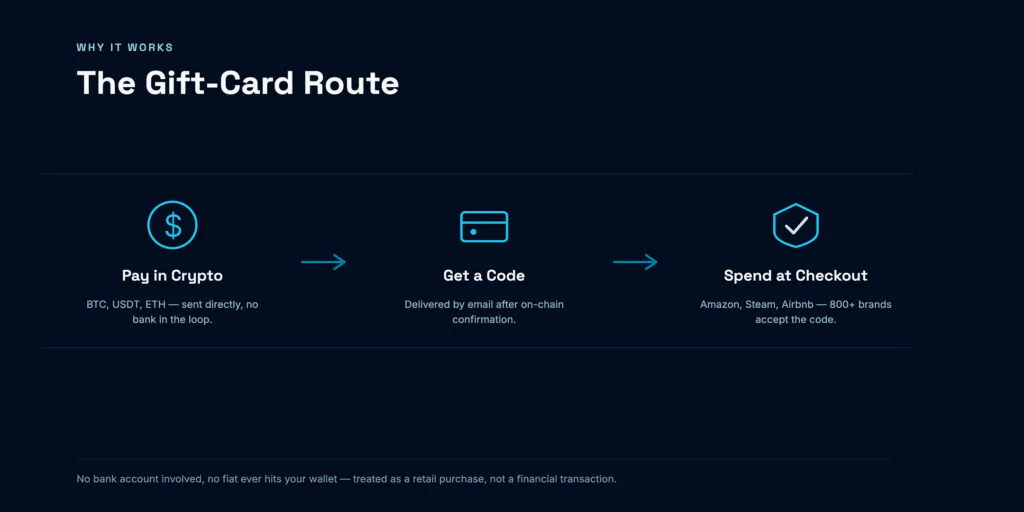
Buying gift cards with crypto sidesteps most of the regulatory complexity around crypto-to-fiat conversion.
You spend crypto directly on a product. The merchant receives fiat on their end (handled by the platform), and you receive a code that works at checkout. No bank account involved, no fiat ever hits your wallet.
For practical spending — Amazon, Steam, gaming, food delivery, streaming services — gift cards cover a wide range of everyday needs. The tradeoff is that your spending is tied to specific merchants rather than being freely spendable cash.
For users who mainly want to use crypto for purchases rather than trading or investment, this is often the most direct and low-friction path available — browse available cards on Cardstorm at cardstorm.io.
What to Watch Out For
“No KYC” claims with small print. Check the actual transaction limits before purchasing. Some platforms advertise no KYC prominently but require it above $100.
Platform shutdowns. The no-KYC crypto card category has seen several shutdowns in 2025–2026 as Visa and Mastercard tightened compliance requirements on card programs. If a platform you’re using issues a physical card, check its current operational status before loading funds.
Gift card scams. The gift card space attracts fraud. Buy only from established platforms with a verifiable track record. Bitrefill, Coinsbee, and Coincards have been operating for several years; Cardstorm has been building its track record since 2024. All four have public reputations to protect.
Tax obligations. Using crypto to buy gift cards is still a taxable event in most jurisdictions — you’re disposing of a capital asset. The no-KYC aspect affects identity verification, not tax reporting. Keep records of your transactions. For more on converting crypto to cash more broadly, see our guide on how to cash out Bitcoin.
The Short Version
Of the three categories covered here, gift card platforms have held up best under regulatory pressure. Crypto debit cards have largely moved toward tiered verification, and P2P exchanges remain viable but require more technical setup. Gift cards are treated as ordinary retail purchases rather than financial transactions, which is why the email-only model has stayed standard across the major platforms.
If you need to spend crypto without creating accounts or uploading IDs, no-KYC crypto platforms built around gift cards are the most reliable option available right now.
FAQ
Do gift cards count as a KYC-free crypto option?
Gift card platforms like Cardstorm don’t require identity verification because gift cards are retail products, not financial instruments. You pay with crypto and receive a code by email — no account or ID required.
Is it legal to buy gift cards with crypto without KYC?
Generally, yes — buying a retail gift card with cryptocurrency isn’t a regulated financial transaction the way a crypto-to-fiat conversion is. Tax obligations still apply, though: using crypto to make a purchase is a taxable disposal event in most countries.
What’s the safest no-KYC crypto option in 2026?
Gift card platforms have the most consistent no-KYC track record. P2P exchanges work but require more setup. Crypto debit cards have largely moved toward tiered verification.
Can I still buy Bitcoin without ID in 2026?
You can, through P2P platforms like Bisq or Bitcoin ATMs for small amounts (usually under $200–$500 depending on location). Larger purchases through centralized exchanges almost always require KYC.
Why do some platforms say “no KYC” but then ask for ID?
Usually because they have tiered limits — no KYC up to a certain amount, then verification kicks in. Check the exact threshold before signing up, not just the headline claim.
Cardstorm lets you buy gift cards across 800+ brands (6,000+ cards) using Bitcoin, USDT, ETH, and other cryptocurrencies — no account or ID required, just an email for delivery. Browse cards at cardstorm.io